
AI agents: from answering to acting
Most people still use AI in the same way: you ask a question, AI gives an answer and then you do something with that answer yourself. An AI agent goes a step further. You do not just give it a question, you give it a goal. The agent can then gather information, use systems and decide, based on the situation, which next step is needed. That turns AI from a tool that supplies information into software that genuinely becomes part of the process.
From answer to action
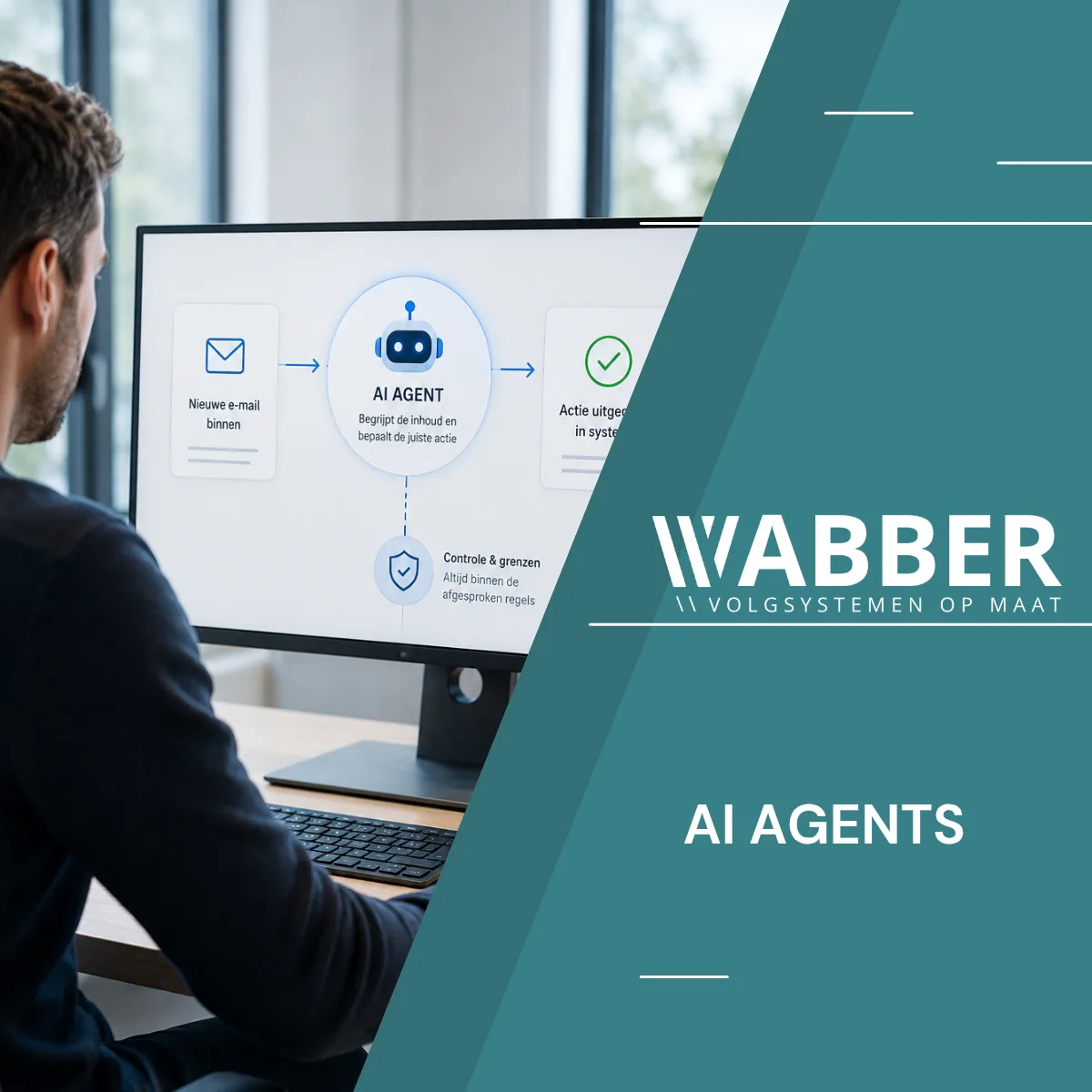
Suppose a customer sends an email about a delivery. An AI model can read the email and work out what the question is about. An agent can then look up the delivery in question, combine data from different systems and determine which next step is needed. So the difference is not only in what AI understands, but above all in what AI can do next. For that, an agent needs access to other software. Think of APIs, internal applications, databases or other systems. Within those boundaries the agent can decide which information is needed and which steps have to be carried out.
Is that not just a workflow?
Companies have been automating processes with workflows for years. If A happens, carry out B. If a certain condition is met, start the next step. When every possible step is known in advance, that works perfectly well. You usually do not need an AI agent for it. It gets interesting when software first has to understand what is going on before it becomes clear which next step is needed. An email can be written in dozens of ways while the desired action stays the same. A document can hold relevant information without that information sitting in the same place every time. Or information from several sources has to be combined before it becomes clear what needs to happen. That is where AI adds something that is far harder to build with fixed rules.
More autonomy also means more risk
As long as AI only gives an answer, an employee usually remains the final check. With an agent that can change. If AI creates a task on its own and makes the wrong call there, it may well be easy to put right. But when an agent changes data, informs a customer or carries out an action inside a business-critical system, the consequences can be bigger. A wrong answer in ChatGPT you can ignore. A wrong action in a business process is another story. So building an agent does not mean giving AI as much freedom as possible. The technology should be part of software that decides where that freedom begins and ends.
Not everything has to be autonomous
The rise of AI agents is sometimes presented as a step towards fully autonomous processes. But that does not have to be the goal at all. Sometimes an agent can gather information and prepare a next step on its own, after which an employee only has to approve it. In other situations the risk is so small that an action can be carried out fully automatically. And for processes that are entirely predictable, traditional software often remains the better solution. The strength lies in the combination. AI can interpret information and handle situations that are hard to capture fully in rules up front. Traditional software then provides structure, control and reliable execution. So the question is less and less whether AI can carry out an action on its own. What matters far more is what happens if that action is wrong, which limits you built in beforehand and who remains responsible in the end. That is where the difference begins between an interesting AI demo and an AI agent you can genuinely rely on inside a business.
Marketing Coordinator at Wabber B.V.