

AI Accuracy
Traditional software is predictable. Give it the same input under the same circumstances and you expect the same outcome. With AI it works differently.
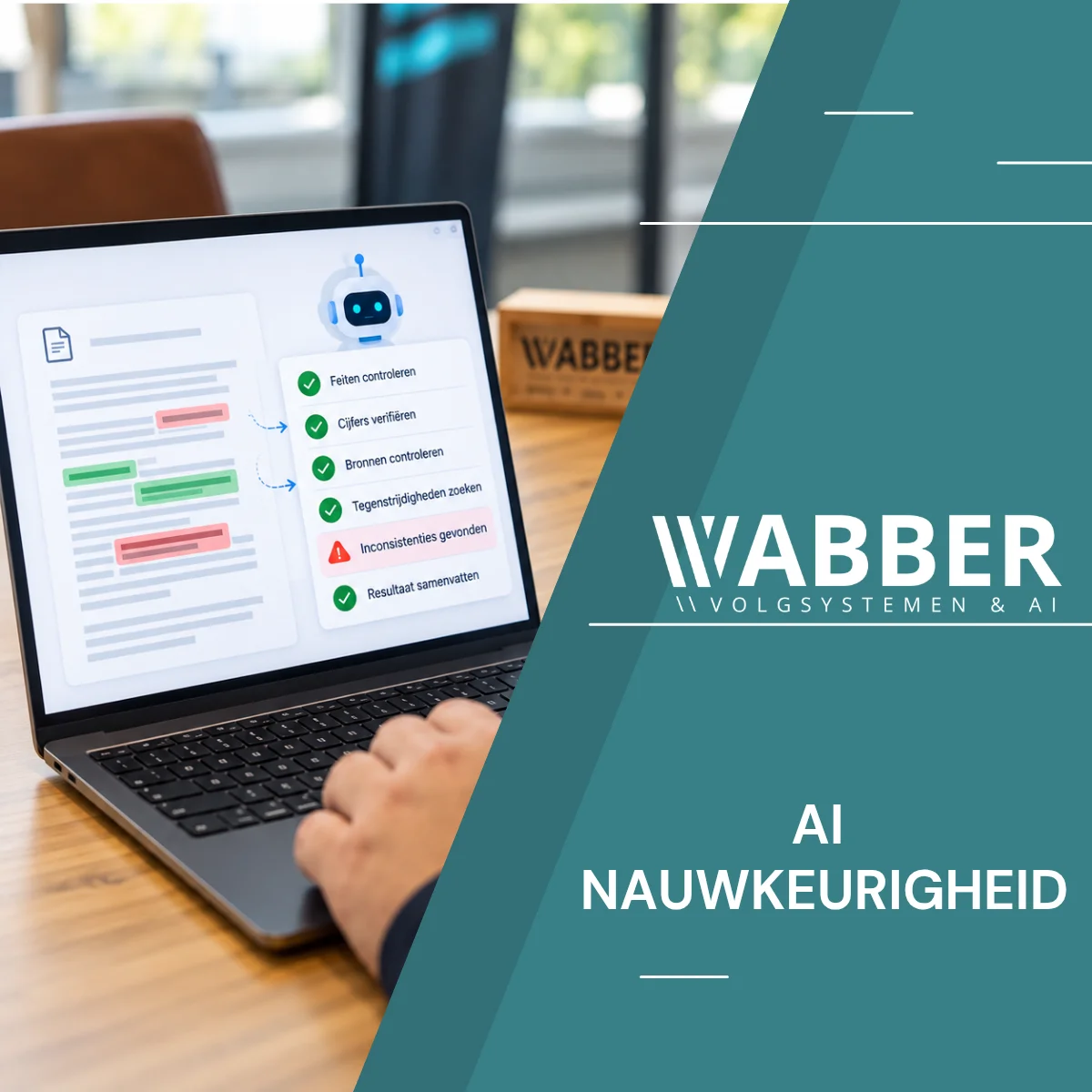
When is AI good enough?
A language model predicts what is probably the right answer. That is why an AI solution can perform impressively well without every outcome being guaranteed correct. For an experiment that is usually not a problem. For software that becomes part of a business process it is. So when is AI actually good enough?
95 per cent can be excellent
Suppose employees classify a thousand documents by hand every day. AI gets 95 per cent of them right. That also means fifty documents are classified incorrectly. That immediately sounds like a poor solution. But if employees themselves classify 90 per cent correctly, the same AI is suddenly an improvement. So the percentage on its own says little. You have to know what happens when the model makes a mistake. A wrong category that an employee easily corrects later has a different impact than a mistake that causes a payment, a delivery or a medical procedure to be carried out incorrectly.
Not every mistake matters equally
That is why with AI we prefer to look at risk rather than accuracy alone. For an internal summary, 95 per cent may well be more than enough. For automatically changing critical data, even 99 per cent can be insufficient. It also means not every AI outcome has to be treated the same way. A model can indicate how certain it is, after which uncertain situations automatically go to an employee. You can check important data with traditional software, or require an employee to approve before an action is actually carried out. So AI does not have to be perfect to be usable. The software around it only has to account for the fact that AI is not perfect.
Testing with real exceptions
A demo often works with examples where we roughly know what is going to happen. Practice, by contrast, consists of exceptions. An oddly worded document. Missing information. Contradictory data. A customer who writes something completely different from what you expected. That is why an AI demo says little about reliability in production. You have to test with real data, collect exceptions and measure where the model makes mistakes. Not once before an application goes live, but afterwards as well.
Build around uncertainty
Deploying AI reliably therefore does not mean waiting for a model that never makes mistakes again. It means deciding where mistakes are acceptable, where checks are needed and where AI should not be making a decision at all. Sometimes AI can carry out a process end to end. Sometimes it should only prepare information for an employee. And sometimes traditional software is simply the better solution. So the question is not whether AI is 100 per cent reliable. It is not. The question is how much certainty your process needs and how you absorb the remaining uncertainty. That is where reliable AI begins.
Also read
Marketing Coordinator at Wabber B.V.