

287 hours a year lost to searching
Do the maths and 287 hours a year works out at just over an hour per working day, per employee, spent retrieving information your organisation already owns. Those hours appear on no timesheet and in no budget. You pay for them all the same, every single month.
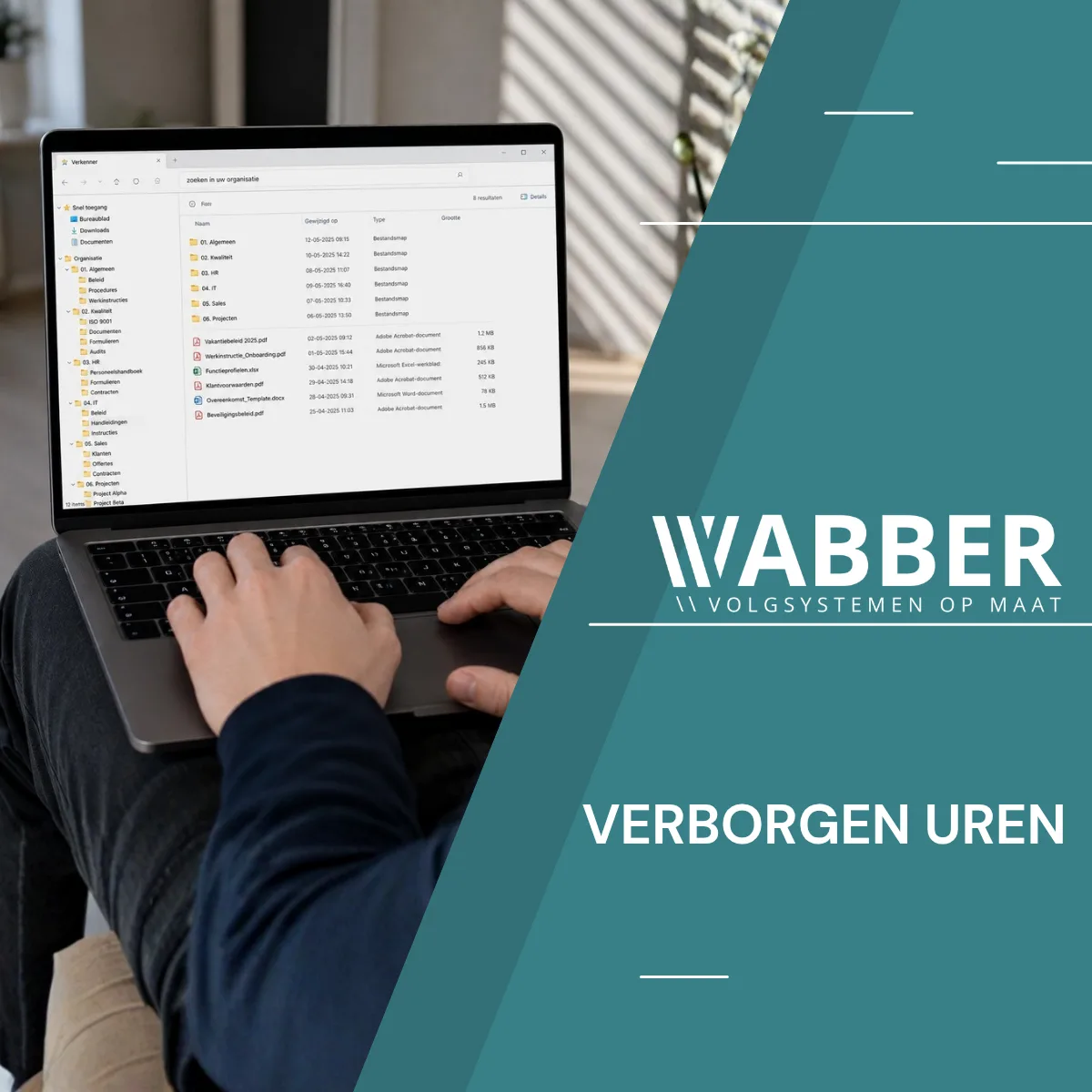
Why you never see those hours
Search time never comes in one big block. It is five minutes in a mailbox, ten minutes in a shared drive, and a colleague pulled off his own work because he does have the latest version of that work instruction. Nobody logs it, because on its own it is nothing. Added up it is almost seven working weeks per employee.
What it costs, in money
Put an internal rate of 45 euro against it and you are looking at nearly 13,000 euro per employee per year. For a team of eight that is well over a hundred thousand. This is not a cost you can cut, because the work still has to happen. It is a cost you can shrink by making the information easier to find.
Searching is not the problem, finding without certainty is
The expensive scenario is not someone searching for a long time. The expensive scenario is someone quickly finding something outdated and acting on it. A public language model makes that worse: it answers fast, sounds convincing and does not show where the answer came from. You then trade search time for verification time, and that is not a gain.
Sound familiar? Let us take a look.
Get in touch →What a RAG platform changes here
A RAG platform answers the question from your own documentation and puts the source underneath it. If the answer is not in there, the system says so instead of inventing something plausible. For a national professional association we built exactly that: a question in plain language, an answer from their own regulations, source attached. The verification step does not disappear, but it takes seconds instead of half an hour.
Measure first, build second
This week, ask three people what they searched for and how long it took. Within a day you have a list no consultancy report can beat. If you recognise your own organisation in those 287 hours, the first question is not which AI you pick, but how searchable your documentation is. We are happy to spend an hour looking at that with you.
Marketing Coordinator at Wabber B.V.